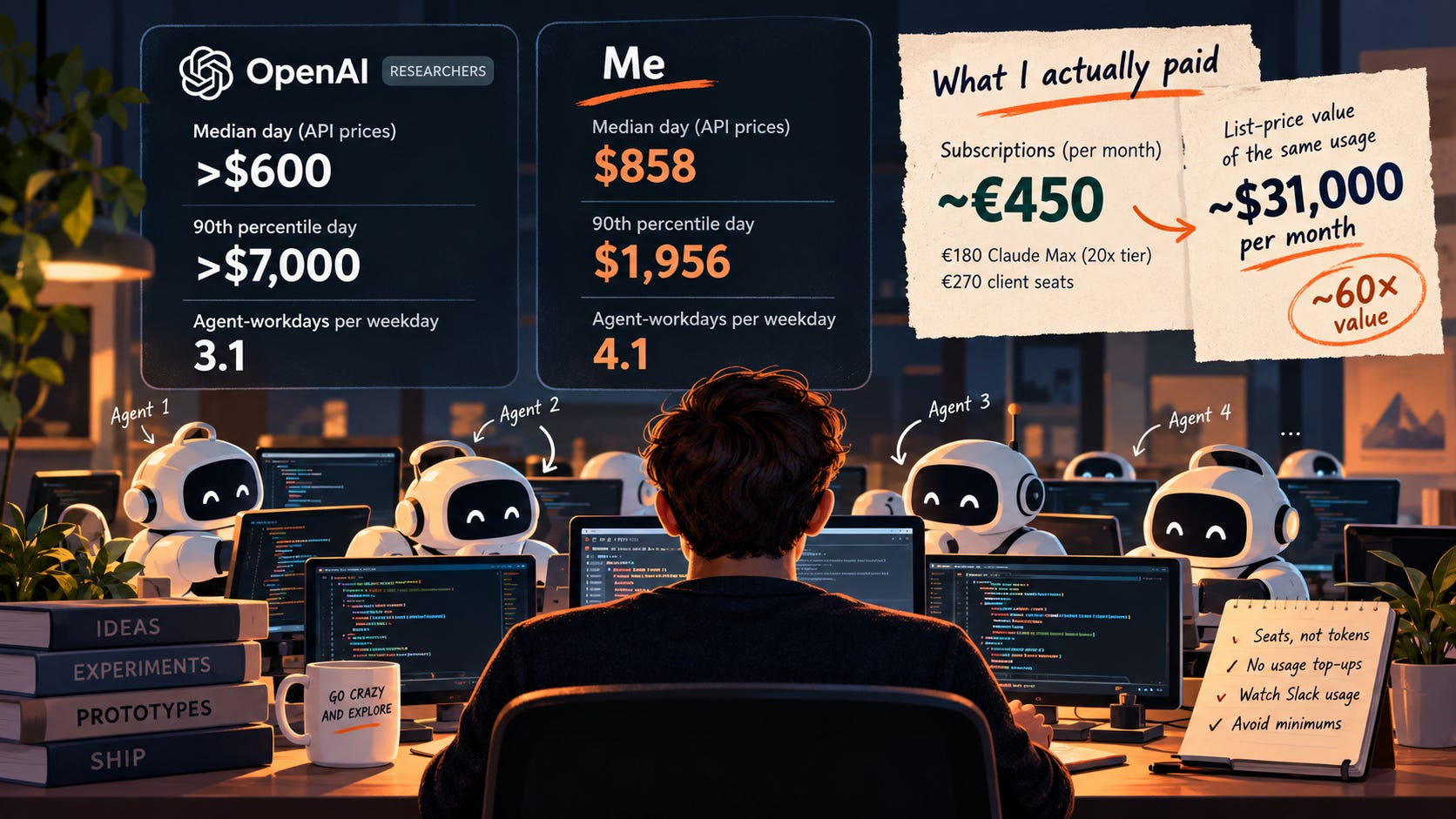
Last month OpenAI published a look inside its research organisation where they measured how much their researchers actually use coding agents (https://openai.com/index/research-acceleration-view-inside-openai/). The numbers that stood out to me were that the median researcher now uses more than $600 a day of inference at API prices, and the 90th percentile more than $7,000. Then a friend of mine ran the same stats on their own Claude Code and Codex usage (https://lnkd.in/p/dTux6dYS), and I couldn't resist doing it too, partly because I was curious and partly because I suspected the result would help with a conversation I keep having with companies about how to pay for all of this.
So I pointed Claude Code at its own transcripts: every session I ran, subagents included, deduplicated and priced at Anthropic's list prices, for the 49 days from 6 August to 23 September. Headless automation is excluded, so this is only what I ran interactively.
If you are the one deciding how your organisation pays for AI coding tools, this is worth a few minutes of your time, because the difference between paying for seats and paying per token is big enough that getting it right can save a company of any real size millions a year.
The numbers
Here is how my seven weeks compare with OpenAI's figures:
Median day at API prices: $858 for me, against more than $600 for OpenAI's median researcher.
90th-percentile day: $1,956 for me, against more than $7,000 at OpenAI's 90th percentile.
Total over the 49 days: $49,953.
Agent-workdays per weekday: 4.1 for me, against 3.1 agent-workdays per human workday across OpenAI's research organisation.
Days with 4 or more agents running at once: at least 46 of the 49.
The agent-workday figure is OpenAI's way of comparing agent runtime with human time: 8 hours of agents working counts as one workday. I averaged 4.1 of those for every weekday, and my busiest week had 344 agent-hours in it, which is about eight and a half full-time people if you insist on the comparison (I don't, really, but it does say something about where the work is happening now).
What I actually paid
None of this was billed per token. All of it ran on subscriptions: a Claude Max plan I pay for myself, which is €180 a month on the 20x tier, and seats that clients pay for, which add up to about another €270 a month. So roughly €450 a month in subscriptions, against usage that at list prices ran at about $31,000 a month, which makes the list-price value something like 60 times what the subscriptions cost.
A couple of months ago I wrote here that a Claude Code subscription costs a company about as much as a phone plan and that I was nowhere near maxing out my own plan. The first half still holds. The second half I'm less sure about now that I have the numbers in front of me.
What I tell companies
This is the part I've actually been advising on with the companies I work with, and the advice has been the same every time: don't leave anyone paying per token.
The reasoning goes like this. A seat has a fixed price and a usage limit. On Anthropic's Team plan a standard seat is $20 a month and a premium seat is $100, billed annually, and the premium seat gives five times the usage of the standard one (https://claude.com/pricing). Per-token billing has no ceiling, and at list prices my ordinary day used up the price of a premium seat within a couple of hours. So anyone on usage-based billing is either costing a lot more than a seat would, or, more likely, they are rationing their usage so it doesn't.
I think the rationing is the worse of the two outcomes, because it quietly kills the learning. What I said in one of these conversations was roughly this: if every time you create something it costs €200, you'll save your tokens, you won't experiment, and therefore you'll never learn. The whole point of rolling out coding agents is that people discover what they can hand over, and that only happens when they try things that might not work. What I would like companies to be able to say to their people is what I wrote in a Slack thread in August: "you are now on a subscription, go crazy and explore what AI can do for you, never worry about token usage costs, don't be afraid."
The catch is that per-token billing has a way of creeping back in even when you've bought seats, through features that are billed by usage on top of the subscription. In practice, the advice breaks down into a few concrete things:
Put everyone on seats, mostly the standard ones, and give premium seats to the people who actually use them. Then measure: a standard seat used to its limit is one unit of usage, and a premium seat used fully is five, and not many people manage five. Start small on premium and move people up when they hit the limit, rather than guessing in advance.
Don't let people buy usage credits when their quota runs out. When someone hits the limit on a paid plan, Claude offers to keep going on usage credits at standard API rates, which is per-token billing again, for exactly the people who use it the most. Upgrade them to a premium seat instead, and if someone is really maxing out a premium seat, give them two seats rather than a top-up.
Think about what you use Claude in Slack for. Tagging Claude in a channel (Claude Tag, as it's called now) draws from a usage balance that the organisation funds, so it's billed per token. A cheaper way that works well enough is for each person on the team to connect Slack to their own Claude through the Slack MCP, so people work with Slack from their own subscription and tag each other instead of tagging Claude. It's a small thing compared to the rest, but it adds up across a team.
Be very careful with anything that puts a minimum usage commitment in front of you, and try to negotiate it away. A commitment means paying for tokens whether or not anyone uses them, at per-token rates, which is exactly the combination you want to avoid.
The most important one is the Enterprise plan. Anthropic's Enterprise plan is now usage-based: you pay a seat fee, and every token your people use, in chat, in Claude Code and in Cowork, is billed at standard API rates on top of it, with no usage included in the seat (https://support.claude.com/en/articles/9797531-what-is-the-enterprise-plan). It's also the only plan with some of the enterprise-specific features, like audit logs, SCIM, custom data retention, customer-managed encryption keys and HIPAA support, so it's the one procurement and compliance people tend to reach for by default. Think twice, and then a third time, before you go with it. You're probably better off reorganising your work so that you don't need the Enterprise plan, because you would be paying something like 20 to 60 times more for features you can most likely work around for a lot less (60 is roughly where my own usage lands, and most people use fewer tokens than I do). More on that in another post.
Is AI worth the investment?
The fact of the matter is that using Claude Code intensively is obviously worthwhile when you're paying subscription prices. But I wouldn't say, not even in my own case, that it would be worth it for me or my clients to pay per token for all of my usage. The value I get from AI is somewhere in between the subscription costs of today and the token-based price of the same usage. I could probably pay a higher subscription, and I would happily pay something like $1,000 a month for what I get out of it, but I would never pay $31,000 a month, and I don't think the value is there for my clients to pay something like $20,000 a month for my usage either. Maybe for highly efficient agent herders it would be, considering they each can provide the value of an entire traditional engineering division, but for most engineers in an organisation it wouldn't: $100 for a premium seat against $3,000 a month extra per engineer is a huge difference, and at that price the "is this worth it" question gets a very different answer.
My guess is that the gap shrinks over time given lower prices and cheaper inference overall, and that the companies that used the cheap subscriptions to actually learn how to work with agents will be in a much better position than the ones that spent it rationing tokens.
If you want to see where you stand, just ask Claude to do an OpenAI-style breakdown as per this or OpenAI’s post. And if you are in the middle of deciding between seats and usage-based billing for your organisation, remember that you can probably do both if you really are forced to use the Enterprise plan for some narrow use cases. There, hopefully reading this saved you a couple of million dollars per year. Until next time!